Parkinson's Disease Training
Authors: Dr H. Zakaria, Mr N. Nash, Miss S. Rowe.
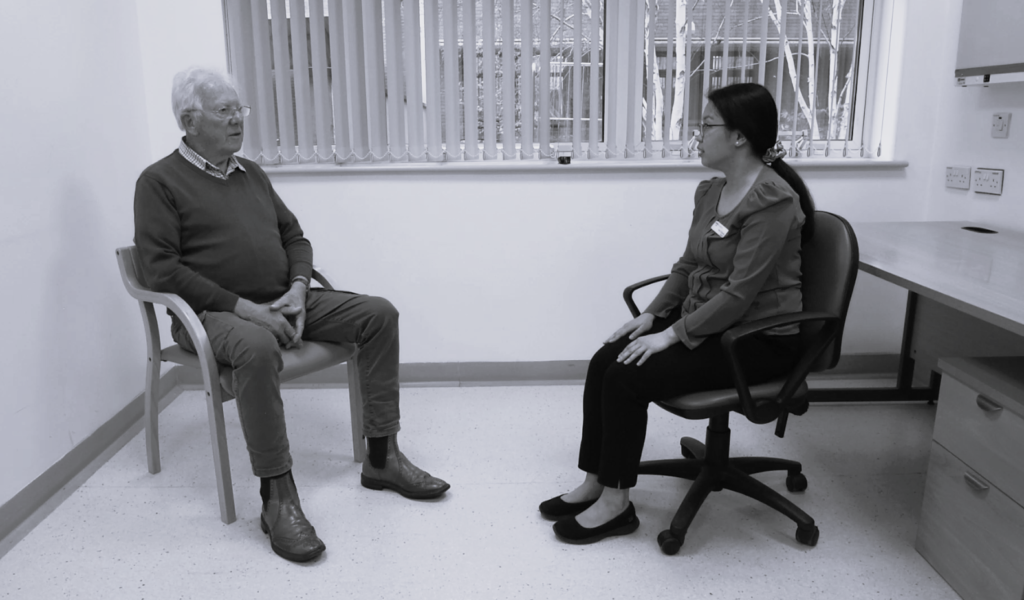
This video has been developed as a training tool for doctors, medical students, and healthcare professionals to explain how to approach patients presenting with tremors, who are referred to the hospital with suspected Parkinson’s disease. It discusses how adopting a good history of the patient and undertaking a neurological examination can inform diagnosis, cause and management of tremors. The video has been created by the Medical Photography Department at Gloucestershire Hospitals NHS Foundation Trust.
Hello everyone.
My name is Dr. Hari Zakaria.
I’m a registrar currently working in Gloucester Royal Hospital.
I’m doing this video to teach how to approach a patient who has been referred to us as a possible case of Parkinson, with tremor as a main presenting complaint.
This teaching video is for everyone from medical students to doctors, and also to health professionals.
This video will be divided into two sections. The first one will be history taking and the second one would be examination.
I have a patient here, Graham, who has clearly agreed to help us out with this teaching.
Thank you so much, Graham. You’re very welcome.
So you were referred by your GP to come and see us because you’re concerned that you might have Parkinson’s and you were more concerned about your tremors.
Can you tell me more about your tremors, please?
Well, the tremor is evident when I try to do fine work, especially when I pick up a cup.
Hmm. If I’m under tension, it is to be a little bit worse, I think.
But drinking from a cup, picking, carrying a cup in saucer, I tend to spill more than I carry.
And yeah, that’s it basically.
And how long have you had this tremor for?
I think about, it’s several years now.
For several years now? Yeah. Okay.
Have you noticed whether it’s worse on any side?
I think the right is a bit worse than the left. Hmm.
Okay. And you mentioned it was worse when you’re drinking using a cup.
Are there any other actions that, that makes a tremor worse?
Writing is, to keep it tidy is quite difficult. Mm-Hmm.
Doing fun work, say putting a small screw in. Mm-Hmm.
That is a bit difficult.
Okay. And have you noticed anything that makes the tremor better?
No.
How about alcohol? When you drink alcohol do you think the tremor gets better?
I don’t think so, no.
Okay.
Okay then, and is the tremor there throughout the whole day or does it come and go?
Pretty well there all the time.
Sometimes worse than others. Hmm, okay.
Especially if I’m a little bit stressed.
Okay. And you said, you said that there were some problems with your writing.
Have you noticed whether your writing was getting smaller?
No. It doesn’t get any smaller.
No. Any problems with your sleep?
No. Have you been waking up in the middle of the night from nightmares?
No.
Have you been waking up at night because your legs were restless?
No. Never. And do you feel like you are more sleepy in the morning?
Sorry? Do you feel like you are more sleepy in the morning?
No, I don’t think so.
Okay. And in terms of walking, has anyone commented that your walking is a bit different now?
No. And I do walk very well. Do very well. Yeah. A lot.
Okay. Have you noticed any changes to your bowel habits?
No. Any problems passing urine? No. Okay.
And have you had recent falls at home? No. Only from, perhaps, a bit from vertigo, which I’ve had for many years. That’s all.
And do you have any family history of tremors? No. Okay.
And besides the tremor, do you have any medical problems that you see the doctors for?
For blood pressure, enlarged prostate. I did suffer from gout. I now take allopurinol every day, so I don’t get gout anymore.
Okay. That’s good. Have you had any previous surgery done to you before
Surgery, I had a road accident. So a road accident. A few years ago, my arm was quite badly damaged. But that’s fixed and it is fine. Okay.
Have any heart disease? No. Any lung disease? No.
Good. And are you taking any medications at the moment?
The blood pressure, gout, and one to stop, me getting up in the middle of the night and going to the toilet.
Okay. Do you remember the names of those medications?
Yeah, I think so. Okay.
Can you tell me the names of the medications please?
Well, allopurinol for the gout. Yeah. I’m on a sym for statin for cholesterol. Lisinopril for blood depression. Yes okay. And a couple of others I just can’t think of at the moment. Okay, that’s fine. Are you allergic to any medications? No. No.
Have you started on any new medications recently?
Yes, one for the blood pressure.
Which was, um, I can’t remember the name of it. I’m only on the first, the first, dose of that actually.
Okay. Okay then. And at home, who do you live with at home?
Wife. The wife.
Do you have a house, a bungalow or flat?
Bungalow? Sorry, a house! You have a house!
And have you got any problems coming up the stairs? No, no.
Okay. And are you still driving? Yes. Good, good.
And are you left-handed or, right-handed. Right.
Right-handed. Okay. Okay then. And do you smoke?
No. No. Do you drink?
Very little. Very little. Very little. Okay.
How much did you say you drink in a week?
One point of beer. Okay.
And did you used to work before this? Yes.
What did you used to work as?
I was a retained fireman for 20 odd years. A retained, retained Fireman. Yeah. And I worked in the general industry all the rest of the time. Yeah. Okay. Okay then.
And, have you got any concerns at the moment regarding your tremor? Is there anything that’s worrying you at moment?
Um, no. Only the sort of, the effect that it has. It does stop me mixing a bit, so for going out for a drink say. Because if I pick the pint up and shake and spill it, it’s more of an embarrassed thing than anything.
Okay.
It doesn’t stop me working or doing DIY or anything like that. So it’s mostly going out and, in case you drop or spill your drinks then?
Yeah. Okay. So have you got any ideas that you know, what you think this tremor might be?
Somebody told me it could be a essential tremor.
Yeah, it could be, yeah. Okay. Okay.
And just to, just to recap, did any of of your family members have tremors?
Sorry? Did any of your family members have tremors? No.
No, no one. Okay. So let’s conclude our history taking section.
It is very important to take a thorough history because it aids us in diagnosing the cause of tremor and also how to manage it.
Parkinson’s tremor are usually unilateral and also is not worse on action.
Essential tremor on the other hand, is tremors on both sides and is worse on action.
It also improves with usually alcohol.
There’s another tremor called dystonic tremor, which is also bilateral and is also worse on action.
Essential tremor can have a family history and it’s also important to take a thorough drug history.
There are some medications that can cause tremors such as antiseptic tremor, domine depleting drugs, inhalers, um, and also anti-emetic medication such as metoclopramide.
It is very important to take a thorough social history, for example, asking the patient if their still driving because if the patient does have Parkinson’s disease, they have to inform the DVLA for that.
We also have to determine whether, how much the tremor is affecting the patient’s life because that will aid us to decide whether to start the patient on medications or not.
In this section, I’ll go through the key elements in examining a patient who has been referred to as a possible Parkinson’s case with tremor as his main symptom.
There are six key elements in examining a patient.
Inspection and observation, tremor, bradykinesia, rigidity, gait and balance, and also functional impairment.
For inspection and observation.
This usually starts from the moment the patient is in a waiting room.
We would usually inspect the patient’s gait while they’re walking into our room.
I’ll go through this further later on in this section.
While I’m taking a history from the patient, I’ll also observe the patient’s face.
We will observe that the patient has a mask like features on his face, reduced blinking, and also with the tremor in a patients lip and jaws.
We’ll also observe the tremor in the hands while we’re talking to them.
For tremors, we’ll inspect first of all, whether there are one side or on both sides. We’ll also see whether they are actually worse at resting or also on action.
So it is important to know what we are looking out for in tremors.
First of all, we need to see whether the tremor is only in one hand or whether the tremor is in both hands.
As you can see here, in Graham’s case, it’s clearly in both hands.
We should also ask the patient to put their arms forward to see if the tremor is also present or even worse in that position.
You can see here. You see that in Graham’s case, the tremor is pretty much the same and is also on both sides.
Thank you Graham, you can put your arms down now. Thank you.
We can also ask them to do the finger nose touching test just to see whether the tremor is worse on action.
Graham, can you touch your nose with your index finger and then touch my finger.
Thank you. And then can you do it with your other hand please, touch your nose and then touch my finger.
Good. And again. So you can see that the tremor is worse on his left arm when he’s trying to touch my finger.
The classic Parkinson’s tremor is something we call a pill-rolling tremor as it mimics someone rolling a pill. It is also usually unilateral and predominantly at rest.
It’s important for us to do further investigations to rule out other causes of tremor.
Essential tremor is usually bilateral and it’s worse on action.
There’s also another tremor, which is called dystonic tremor, which is also unilateral and it’s also worse on action, on a specific action like posture. This is quite different from essential tremor as the tremor is described as a jerking movement or a spasm of the muscle.
In dystonic tremor, you might also see atrophy of the muscle that it affects.
The next thing we will look out for is rigidity. Rigidity is increased muscle tone, however, lacks spasticity. It is not directional dependent, nor it is speed dependent. The best way to describe cogwheel rigidity in Parkinson’s is the muscles will move in small increments similar to how a cog wheel moves. It may be quite subtle in early disease and also in Parkinson’s who are well medicated. Tremors can interfere with the rigidity and it may give us a false impression of cogwheel rigidity.
So Graham, can you just relax for me and then I’ll be trying to test for your muscle tone.
The best place to examine someone’s rigidity is in the wrist. So we’ll have to make small but actually quick turns.
Okay, that’s good. Can I do this one as well? Good.
That’s good. You can place your hands now.
Next part is the elbow. Do you have any pain in your elbows Graham?
Only this one from my accident.
Okay. Can I deliver that one first then? Yeah. Okay.
Okay. So you’ll have to make it as quick. Okay, that’s good.
Good. Can I examine that one as well? Yes, certainly.
Okay. I’ll be careful.
Okay, that’s fine. Good.
Another important element of this examination is bradykinesia, which is in between slowing down of movement. It is important for us to ask the patient to do repetitive movement as big and also as far as they can.
Graham, can you please tap your index finger and your thumb finger on both hands like this?
Okay. We have to ask them to do a good number of repetition for us to see the changes.
Can you do it for 10 times please Graham?
1, 2, 3, 4, 5, 6, 7, 8, 9, 10. Good, thank you.
Well, what we’re looking out for is slowing down, resetting, but also pauses in his movement. Besides those movements, we can also, there’s another maneuver that we can try, which is pronation and supination.
Graham, can you please copy me like this?
So yeah, that’s good. So use your left hand and turn it around like that for 10 times.
As fast as you can. 5, 6, 7, 8,9, 10. Perfect. That was very good.
Can you do it with other hand please.
1, 2, 3, 4, 5, 6, 7, 8, 9, 10. Good.
Very good. Besides the hands, we could also test bradykinesia in their feet.
We’ll ask them to tap one foot in at a time for 10 times.
So can Graham, can you tap your right foot as fast as you can for 10 times?
5, 6, 7, 8, 9, 10. Perfect.
And can you do the other one please as well?
1, 2, 3, 4, 5, 6, 7, 8, 9, 10.
Good. In Parkinson’s disease, you would see sorts of changes such as slowing down of movement and also some pauses as well.
Assessing someone’s gait balance is also a key element in the examination.
It gives us an idea of the risk for the patient falling and also how they’re walking.
There are three elements in this section, which is sit to stand, the pull test, and also the gait.
First of all, I’ll ask Graham to stand from where he’s sitting with his arms crossed across his chest.
Graham, would you mind trying to stand up with your arms across your chest please?
The next test is a pull test.
The main reason for why we’re doing this test is to see how good they are with the balance.
What we do is that we pull on a patient’s shoulder backwards and see whether they can correct themselves in one or two steps.
Some patients might take a few more steps, however they’re unable to correct their sense of gravity.
Then these are the patients that we are worried about. Graham, I’m just going to stand behind your back and then I’ll pull your shoulders.
Okay. If you can try and keep yourself in this spot, that would be good.
Right. So make sure you warn the patient first and also make sure that you’re standing behind the patient just in case they fall.
So Graham, I’m just going to pull your shoulder. Okay?
Yes. And one more time.
As you can see, Graham was able to maintain a sense of gravity without taking any steps.
So this means that he is at a low risk of falling. Thank you Graham.
Next is walking.
Things we look out for in gait are stooped posture, reduced arm swing, shuffling gait or flat foot gait, reduced step length, difficulties in turning and freezing.
Freezing is when the gait is halting and patients usually describe it as their feet are stuck, stuck to the ground.
The last element of our examination is assessing someone’s functional impairment.
In Parkinson’s disease, the patient’s handwriting may become smaller, something we call micrographia. We ask the patient to write a sentence. It can either be what they had for breakfast or what they did yesterday.
Graham, would you mind writing me what you had for breakfast please?
Yesterday.
Perfect, thank you.
As you can see here, Graham’s handwriting did not become smaller.
In Parkinson’s it can be very obvious, however, it doesn’t always present in Parkinson’s cases.
Another test that we can do to assess a patient’s functional impairment is asking them to draw a spiral.
Drawing a spiral is a very complex action and it needs a lot of coordination, something that Parkinson’s patients may have difficulties with.
Great. Can I ask you to draw a spiral for me please as well?
I don’t know how to draw a spiral. Okay.
Can you draw this spiral? So if I show you a spiral, like this.
Oh, that one? Yeah, that one.
Can you try to draw it there?
Okay,
Thank you.
Okay, that’s good.
This concludes our examination section.
We use the examination to diagnose and also to rule out Parkinson’s.
Besides that, we also examined the patient during follow up to see how much their symptoms have changed.
It’s important that not only when we examine them, we also ask the patient how much these symptoms are affecting their lives.
We don’t necessarily have to change a medication if they are not significantly affecting their daily activities. However, I will refer to physiotherapy early into the diagnosis to prevent from rapid duration of the gait and balance.
Thank you so much Graham, for your time.
You’re very welcome. Okay. We do appreciate help here.
Thanks so much for watching the video.